.png)


⚡️ 1-Minute DISCO Download
The Electronic Discovery Reference Model (EDRM) is the standard roadmap for the ediscovery process, acting as a systematic funnel that reduces millions of pages of data to a precise collection of courtroom-ready evidence. It splits into two phases: a proactive, day-to-day data management phase (information governance) and an active, project-based workflow that kicks in the moment a lawsuit hits.
💬Key Quote: “The EDRM may look like a linear workflow, but in practice, it isn’t rigid or sequential. Real-world litigation is fluid.”
🌊Dive Deeper: For a clear look at how the legal mandates tie into technical execution, check out "How Does the EDRM Relate to the FRCP?" It breaks down how Rules 26, 34, and 37 act as the strict legal rules (the what you must do), while the EDRM serves as your practical map (the how to do it).
Digital discovery is notoriously unpredictable, which is why the Ediscovery Reference Model (EDRM) was built. It gives legal teams a standardized playbook to handle massive volumes of electronically stored information (ESI) without missing critical steps.
This comprehensive guide details how the EDRM is structured, how it works in practice, and breaks down each of its nine distinct stages to help teams build a more efficient, rigorous ediscovery workflow.
What is EDRM?
The EDRM (Ediscovery Reference Model) is a framework that provides the vital structural foundation for repeatable, legally compliant ediscovery practice. By understanding its non-linear nature and treating it as an adaptable roadmap, teams can significantly lower data management costs, minimize risk, and confidently navigate the complexities of modern digital evidence.
How the EDRM is structured
The EDRM is the standard roadmap for the ediscovery process, acting as a systematic funnel that reduces a mountain of raw corporate data to a precise collection of courtroom-ready evidence.
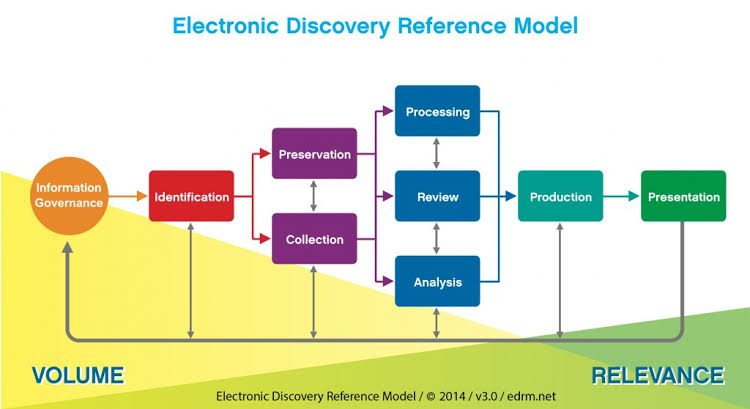
The process splits into two main phases, starting with information governance, an ongoing corporate process of managing and organizing its data before any legal trouble begins.
Once a lawsuit or investigation hits, the rest of the EDRM kicks in as a project-based workflow. During this reactive phase, teams guide data through a step-by-step pipeline that filters out irrelevant data until only vital evidence remains.
Get the guide: Ediscovery 101: Guide to Ediscovery Rules and Best Practices
How the EDRM works in practice
The EDRM may look like a linear workflow, but in practice, it isn’t rigid or sequential. Real-world litigation is fluid. Teams may be deep in the document review phase when a witness reveals a completely new chat app, forcing them to circle back to identify and collect that new data source.
The framework ensures they have a legally compliant, step-by-step roadmap.
9 EDRM stages of discovery
Across the EDRM, each individual stage has a distinct operational role to play:
1. Information governance
As the proactive foundation of the EDRM, information governance (IG) is the ongoing management of an organization’s data before a dispute ever arises.
It requires companies to map their entire digital ecosystem—from traditional email servers to collaborative tools like Slack or Teams—and use strict retention schedules to decide what to keep and what to safely delete. By systematically minimizing data bloat, organizations protect themselves from massive downstream discovery costs and severe regulatory exposure the moment a lawsuit hits.
2. Identification
When litigation is reasonably anticipated, the active discovery lifecycle begins with identification. During this phase, legal counsel and IT teams pinpoint potential sources of relevant ESI and the individuals who control them, known as custodians.
This means mapping out employee hard drives, cloud storage repositories, and mobile devices to pinpoint where potentially relevant records live. Finding these sources accurately at the start of a matter ensures teams know what needs to be protected and prevents them from missing key evidence or overcollecting massive amounts of expensive data later.
3. Preservation
The primary objective of preservation is to protect potentially relevant data from spoliation. This stage is initiated by issuing a formal legal hold to all identified custodians, instructing them not to delete or modify data.
Download our worksheet: Custodian and Collection Tracker
Simultaneously, the legal team issues a data steward notice to the IT department. This directs IT directors to immediately suspend automatic email deletion, server recycling, and backup overwrite schedules, locking the organization's backend systems in place while the legal team determines its next steps.
Get centralized cloud collection that streamlines hold-to-collect workflows — all from a single platform. Learn more.
4. Collection
Once data is identified and safely preserved, collection involves gathering the ESI for processing and review. Because a case’s success can hinge on data integrity, teams must extract data using forensically sound methods that preserve metadata.
Shoddy collection techniques can alter metadata and render crucial evidence inadmissible in court, making standardized, audited extraction protocols non-negotiable. Learn how to plan and execute defensible collections.
Need help? DISCO provides a full suite of forensic services.
5. Processing
During the processing phase, ediscovery specialists load the data into specialized software to prepare it for human review. Raw files from a company's servers are usually a messy mix of formats. Processing standardizes them and makes text fully searchable, so legal teams can use keywords to find key information.
For example, Cecilia Q&A enables teams to interrogate the evidence by asking questions about the case and getting answers supported by cited documents in the database.
This stage is also the first major opportunity to shrink the data pile before review begins. The software automatically strips out unnecessary background files, such as computer code, and deletes duplicates across the entire collection. By letting technology handle this heavy lifting upfront, teams can quickly slice the data mountain down to size, saving both time and money.
Read the case study, From 1.4 Million Documents to Production in 4 Weeks, to learn how DISCO’s high-speed uploader helped one team ingest and process the first 1.2 million documents into the platform in just eight hours.
6. Review
Review is historically the most labor-intensive and expensive stage of the entire EDRM. During this phase, legal teams examine processed documents to determine relevance to the matter, categorize files by topic, and identify confidential or privileged communications that must be withheld from the opposition.
To keep costs from spiraling, teams leverage technology-assisted review (TAR) and legal AI tools to prioritize the data pile. Instead of reading files in a top-down sequence, reviewers use the software to surface the most important documents first and filter out obvious junk.
AI tools like DISCO Auto Review can also do the first-pass review. And it can complete it in hours, with 10–20% higher precision and recall than human reviewers.
These same tools facilitate Early Case Assessment (ECA), analyzing key concepts and communication patterns to give legal teams a high-level view of their financial exposure and case strategy before deep review even begins.
7. Analysis
During this phase, teams use advanced software to uncover patterns, map communication threads, and build case timelines across the entire dataset.
By analyzing who was talking to whom, identifying sudden spikes in chat activity, or tracking specific jargon, teams can piece together the actual context of a matter.
Tools like DISCO Deposition Management allow teams to pull these findings directly into deposition prep and trial strategy, turning data patterns into a clear case story.
8. Production
Production is the formal delivery of relevant data to opposing counsel. Because formatting errors, broken links, or accidentally leaking privileged information can trigger severe court sanctions, execution must be flawless.
To prevent costly slip-ups, teams rely heavily on precise redactions during the final push. DISCO’s intuitive document viewer allows reviewers to quickly apply, edit, and audit mass redactions in a single workspace, ensuring protected information stays hidden before the data leaves the building.
9. Presentation
The final stage of the EDRM is presentation, where teams place their curated evidence before a trier of fact. The goal is to synthesize complex digital evidence into clear, compelling arguments that persuade the court. This means creating trial graphics, managing video depositions, and organizing digital exhibits to tell a coherent story that supports the case strategy.
EDRM stage comparison
Here is a quick look at how the nine stages fit together across the overall workflow:
EDRM framework and community
Co-founded in 2005 by George Socha and Tom Gelbmann to standardize an emerging market, the EDRM has evolved from a procedural framework into a global alliance of legal and technical experts. Today, this network collaboratively sets the industry benchmarks, whitepapers, and resources necessary to navigate rapid technological shifts.
As a Guardian Plus Partner, DISCO works at the core of this global alliance, directly helping shape and advance the standards that guide modern ediscovery workflows.
EDRM and modern ESI
The explosive growth of modern ESI types has tested the traditional boundaries of the EDRM. Teams face fragmented, short-form data streams from tools like Slack, Microsoft Teams, WhatsApp, and ephemeral messaging apps.
Ediscovery tools must continually reshape how conversation threads are identified, preserved, and collected as cohesive units rather than isolated files.
DISCO leads the charge with its all-inclusive platform. Learn how our cutting-edge legal AI can be with you in every case.
How does the EDRM relate to the FRCP?
The Federal Rules of Civil Procedure (FRCP) — specifically Rules 26, 34, and 37 — legally dictate an organization's duties regarding discovery scope, timing, and evidence preservation.
Think of the FRCP as the strict legal mandate (the what you must do) and the EDRM as the highly practical, technical framework (the how to execute it defensibly).
What is the difference between the EDRM and the IGRM?
The Information Governance Reference Model (IGRM) is a specialized framework under the EDRM umbrella that targets a different scope. While the EDRM covers the entire, end-to-end litigation lifecycle, the IGRM focuses exclusively on the first step: Information Governance.
The IGRM outlines how corporate stakeholders should collaborate to balance data utility with risk and cost management before litigation is triggered.
Note: This is a proposed change under EDRM 2.0. Read more here.
Manage ediscovery with DISCO
DISCO’s platform handles data across the entire EDRM workflow, connecting collection, processing, and review in a single interface. By pairing a fast cloud architecture with built-in AI, the software automates early data culling and accelerates document review — helping legal teams find key evidence without the traditional manual bottlenecks.
Ready to transform how your team handles complex data volumes?
- Explore DISCO ediscovery software to optimize your operations.
- Leverage cutting-edge Cecilia legal AI software to fast-track your document analysis.
- Schedule a demo today to see it in action.



.webp)