⚡️ 1-Minute DISCO Download
In case you missed it, the Electronic Discovery Reference Model (EDRM) is getting updated – a project we’re calling EDRM 2.0. Today, I’m excited to share the proposed changes, the rationale behind each, and the impact these changes will have on the way we practice ediscovery.
The previous EDRM model has its merits, and we even took a serious look at leaving well enough alone. But we felt there were some key tweaks that needed to be made to keep the model current.
EDRM 2.0 (Proposed Model):
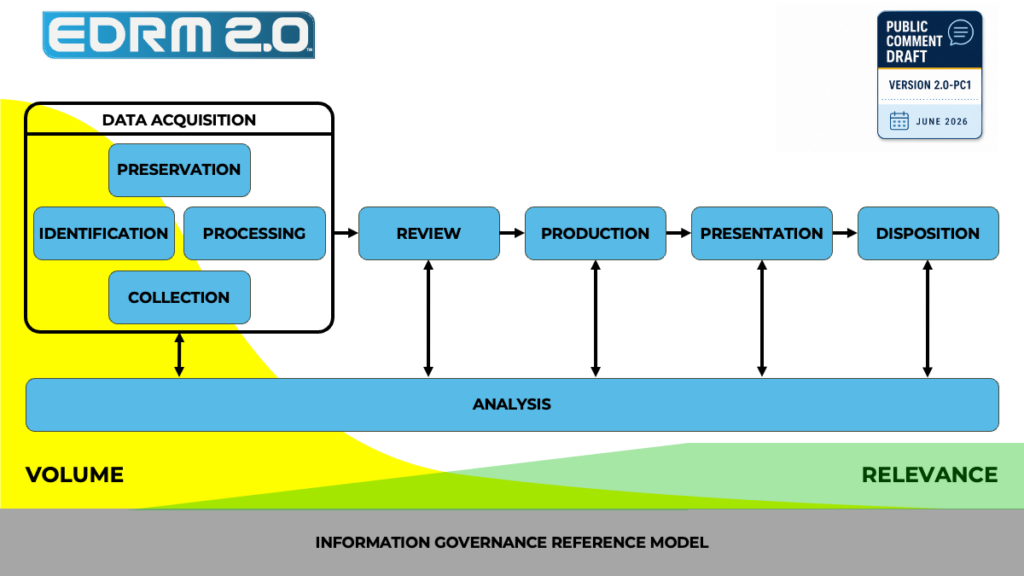
Image: EDRM 2.0 Project Team.
Change #1: Repositioning the Informational Governance Model (IGRM) and introducing a disposition phase
Information governance is foundational to the EDRM. Previously, the Information Governance Reference Model (IGRM) was off to the side and often ignored or mentioned briefly in passing when explaining the EDRM. In the 2.0 update, IGRM is depicted as a foundation for the model that should influence and govern every stage in the EDRM.
The new and necessary disposition phase accounts for defensibly handling the data after its usage is complete.
Rian Kennedy, Director, Legal Hold Sales for DISCO and the Co-Project Trustee for EDRM 2.0
Additionally, a standalone “disposition” phase was added to the EDRM. The new and necessary disposition phase accounts for defensibly handling the data after its usage is complete. This can include deletion, archive, moving back into normal retention, or other processes.
Why does this matter?
As data security and privacy concerns increase for corporations, the handling of their data for legal purposes has come under intense scrutiny. By emphasizing the necessity of IGRM principles and following disposition workflows, legal teams can ensure steps are taken to handle this data with care throughout their use of it and after they are finished with the matter or investigation.
Change #2: Expanding the analysis step into a full-process, connective phase
Analysis was just another phase in the original EDRM that often referred to the use of analytics tools, TAR workflows, ECA, and other pre-review insight into data. As the team discussed, analysis seemed to stretch further left and further right in the model. Rather than a single phase that was revisited, our conversations led us to a model where analysis spanned across all phases and served as the connector between the rest.
Analysis is no longer a siloed step you perform and then forget. This shift highlights the need for continuous assessment and data-driven decision-making.
Rian Kennedy, Director, Legal Hold Sales for DISCO and the Co-Project Trustee for EDRM 2.0
Analysis now expands beyond the original definition to add continuous insight and feedback loops from all stages, helping inform decisions from identification all the way through to production and even disposition. This means leveraging data-driven metrics to constantly evaluate strategy, efficiency, and defensibility across the entire matter.
Why does this matter?
Analysis is no longer a siloed step you perform and then forget. This shift highlights the need for continuous assessment and data-driven decision-making. By illustrating how analysis happens throughout the EDRM, legal teams make better-informed strategic choices and drastically improve efficiency by continually optimizing workflows based on real-time insights into the data. It may not be something new in practice, but this change reflects the reality of how professionals analyze throughout their matters.
Change #3: Grouping the initial steps – preservation, identification, processing and collection – into a Data Acquisition group
Grouping the first four phases together into a data acquisition group reflects the overall move “left” on the EDRM. With in-place indexing and preservation of data at the sources, much more can be done before a review phase. The close tie between collection and preservation remains, and the lines are sometimes blurred between the two. As you identify data, preservation and/or collection can happen simultaneously, and pre-processing, indexing, or full processing may be accomplished at the same time. This greatly differs from the distinct phases defined in the original model.
If you notice, there’s a “wave” depicting the Volume to Relevance continuum. This Data Acquisition group greatly minimizes large data sets very early on while relevance becomes much more clear at the Review phase nexus.
Why does this matter?
By consolidating the initial steps into a single Data Acquisition group, the EDRM acknowledges the reality of modern ediscovery technology. Tools now allow us to perform identification, preservation, collection, and processing with far less distinction between the steps. This “move left” capability allows legal teams to gain early visibility into their data, leading to much faster and more accurate Early Case Assessment (ECA) and, ultimately, significant cost savings by narrowing the scope of data before it hits the review phase. It reflects how technology has made these initial steps simultaneous and sometimes managed by native and 3rd party applications in-place rather than strictly sequential.
Summary of the three key updates
These three updates (the foundational role of Information Governance and the new Disposition phase, the pervasive nature of Analysis, and the grouping of Data Acquisition) represent a significant, and necessary, evolution of the EDRM. We believe that EDRM 2.0 captures the current reality of ediscovery and data management, ensuring the model remains the definitive framework for legal professionals navigating today’s complex data landscape.
Meet the team behind the EDRM 2.0 project
Under EDRM CEO Mary Mack’s and Chair of the Project Trustees Dave Cohen’s direction, the EDRM 2.0 project trustees consist of: Shannon Bales (Munger Tolles), Stephanie Clerkin (Korein Tillery), Brett Burney (Burney Consultants), David Cohen (ATJustice), and myself (DISCO). [It should be noted that Charisma Starr contributed greatly to the conversations early on as a trustee and Kaylee Walstad, before her untimely passing, led this project with wisdom as well.]
There are more than 100 project committee members who also contributed through conversations, voting for changes, adding their proposed models, and more. The project trustees relied heavily on this larger group to shape the EDRM updates. We are truly grateful for this group and especially for the outspoken members who carried as much weight in the updates as the trustees.
And of special note are my DISCO colleagues, Kristin Zmrhal and Alisa McLellan who have helped me form many thoughts around this, too. And finally, the original creators and many shapers of the EDRM cofounders George Socha and Tom Gelbmann (along with industry experts Tom O’Connor, Florinda Baldridge and more!) were able to comment on our update and provide critical feedback as we’ve moved forward with the new model. Thank you.
As we finalize the EDRM 2.0, the committee seeks the community’s feedback. We are officially open for public comment. Learn more at EDRM.net.

.png)

.webp)