


⚡️ 1-Minute DISCO Download
In 2024, the legal profession stood on the brink of a technological watershed moment driven by generative AI (GenAI). In 2025, the floodgates have opened.
A year ago, our survey with The Cowen Group found that legal professionals were largely optimistic, planning for a rapid future of GenAI adoption. Today, the results of our 2025 follow-up survey with Ari Kaplan Advisors show that the conversation has moved from if and when to how – how to scale responsibly and to secure a competitive edge.
This year’s data provides a critical benchmark, revealing a massive surge in implementation, a deepening focus on strategic value, and a clearer picture of the persistent obstacles that must be overcome to achieve true transformation.
Here are the four key takeaways from the 2025 report, highlighting the shifts in the legal landscape.

Key Takeaway 1: Adoption is accelerating
The 2025 report signals that the era of cautious experimentation is over; we are now in the era of active implementation.
The 2024 prediction vs. the 2025 reality
In early 2024, our survey indicated the profession was anticipating rapid change, with:
- 72.5% of legal practitioners already using GenAI or planning to do so within the next two years
- 20.3% of organizations reporting they had already adopted GenAI into their routine legal processes
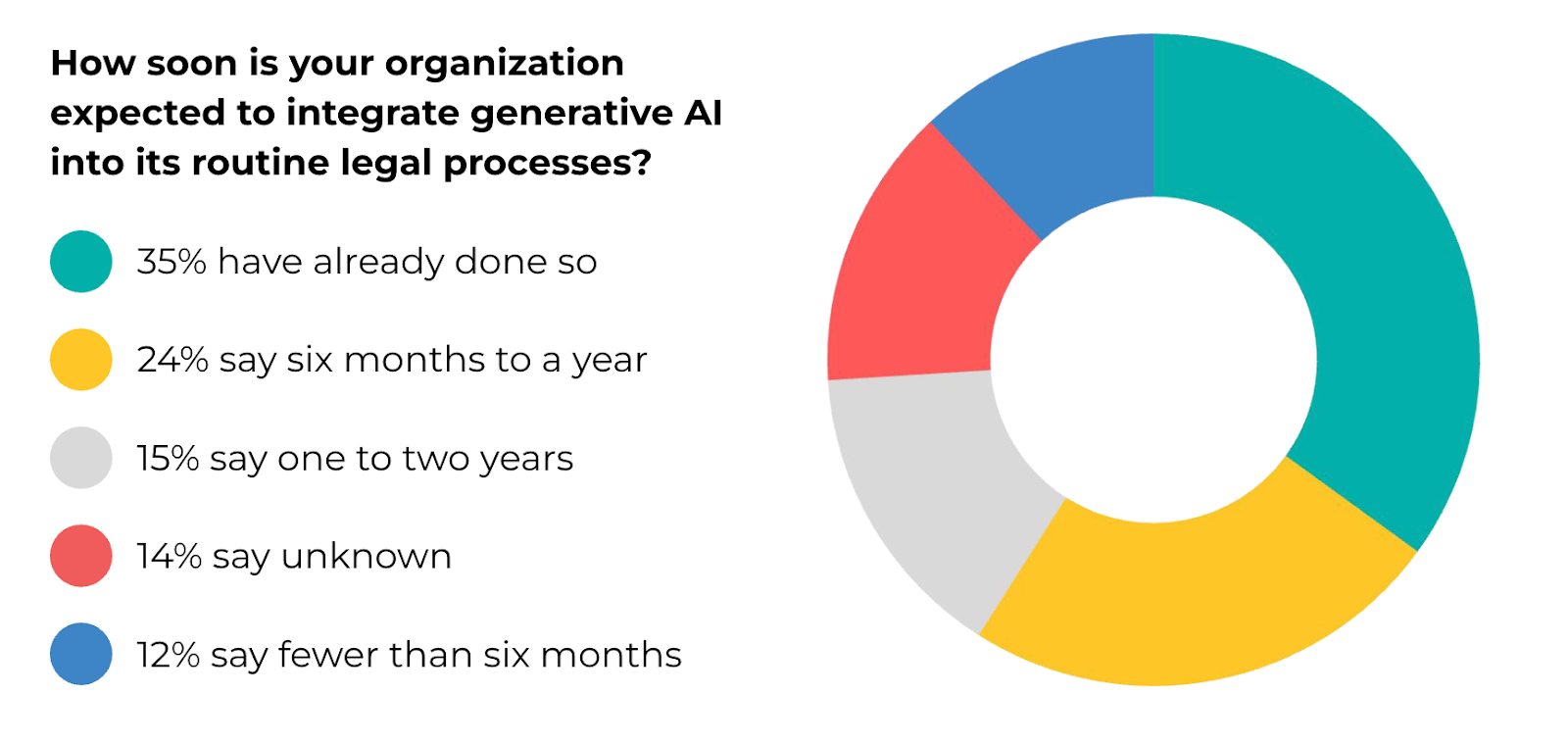
Fast forward to 2025, and the rate of actual, in-practice adoption has surged with 35% of law firms and corporations having already incorporated GenAI into their routine legal processes.
This represents a 72% increase in the number of organizations that have moved from the "plan-to-adopt" stage to the "already-done" stage in just 12 months.
This push to adopt is driven by mounting internal and external pressures, with 43% of law firm participants reporting feeling pressure from their leadership, and 64% of in-house legal participants feeling pressure from their corporate leadership.
The new question is no longer whether to adopt, but how quickly you can do so without compromising client security or ethical standards.
Key takeaway 2: The shift from efficiency to strategic value
In 2024, the primary driver for GenAI adoption was a boost in efficiency (70.8%). While efficiency remains the top benefit in 2025 (70%), the data now points to a more sophisticated and realized vision for the future of legal work.
The core promise of GenAI has always been to free the human lawyer from rote, perfunctory tasks, allowing them to focus on high-level strategy. In 2025, that prediction is becoming the professional reality.
Forty-six percent of our 2025 respondents confirm that they expect the technology to simplify routine tasks and free up more time for complex legal analysis. Another 22% specifically state it will allow more time for strategic work.
This confirms that GenAI is being integrated not to replace the human element, but to amplify it. The lawyer's job is evolving, becoming less about document volume management and more about strategic oversight, pattern recognition, and validating AI insights.
Cost Control Enters the Conversation
A significant shift in 2025 is the new emphasis of GenAI as a tool for cost reduction. While efficiency was the headliner last year, budget is now a major pressure point as well:
- 61% of corporate legal departments cite reducing costs as a key priority for GenAI adoption, second only to improving efficiency
- 56% of all participants say that GenAI is "not yet" a tool for controlling litigation costs, "but it will be soon”
This indicates a forward-looking confidence that GenAI's efficiencies will not just improve workflows, but also reshape the economic model of litigation, making it a critical competitive factor for law firms seeking to attract and retain cost-conscious clients.
🤝 To learn more about initiating confident conversations with your clients about AI, check out our blog here.

Key takeaway 3: Security and privacy remain the #1 blockers
While adoption has surged, concerns around security and privacy have persisted year after year. These apprehensions have not gone away, rather the growing complexity of data has kept them front and center.
- 2024 top concern: Data security and privacy, cited by 74% of respondents.
- 2025 top concern: Data security and privacy remains the number one obstacle, cited by 70% of law firm respondents and 68% of corporate legal departments.
This consistent result underscores a critical paradox: the need for speed is real, but the security and privacy risks are non-negotiable, particularly in high-stakes litigation involving sensitive client data.
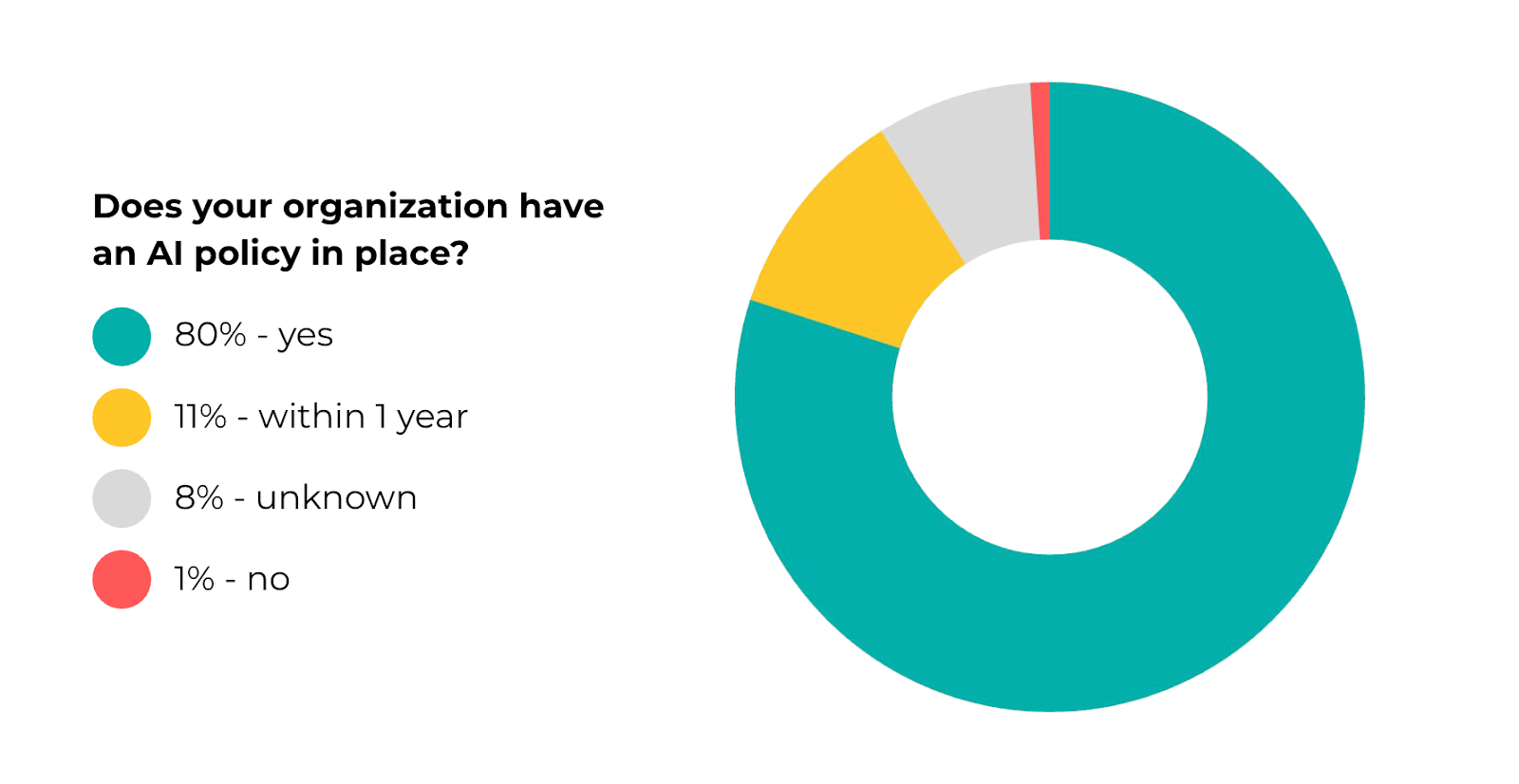
The good news is that the industry is tackling this head-on with governance. A striking 80% of participants report their organizations already have existing AI policies and guidelines in place, with another 11% expecting to implement them within a year. This massive policy shift is the essential countermeasure to the security and ethics fears.
🔒To learn more about key components of an AI policy – and how to implement one – read our blog here.
Key takeaway 4: Document review is the most transformed process
GenAI is already rewriting the rules for specific tasks, and its most immediate impact remains concentrated in the high-volume, text-heavy world of ediscovery.
In 2024, the workflows slated for the most immediate change were document review (81%) and fact investigation (72.5%).
This narrative continues in our 2025 survey. Law firms and corporate legal departments are implementing GenAI as a result of expanding data volume and lengthening litigation lifecycles, with 52% of participants reporting that they are now implementing additional technology simply to keep up with the volume.
When asked to rate their confidence level on a scale of one to five, with five being the highest, in using generative AI for document review compared to traditional manual review methods, more than half (53%) rated it a four or a five, and 79% rated it a three or above.
“Generative AI is reshaping ediscovery by cutting down the noise and surfacing what matters faster; it’s shifting legal’s role from volume review to strategic oversight, spotting patterns, validating insights, and steering the narrative early.”
📄 To learn more about how to use GenAI for document review, check out our guide here.
Download the full report
For a deep dive into respondent predictions, fears, perceived benefits and more about the impact of AI in the legal industry, download the full whitepaper here.

.png)